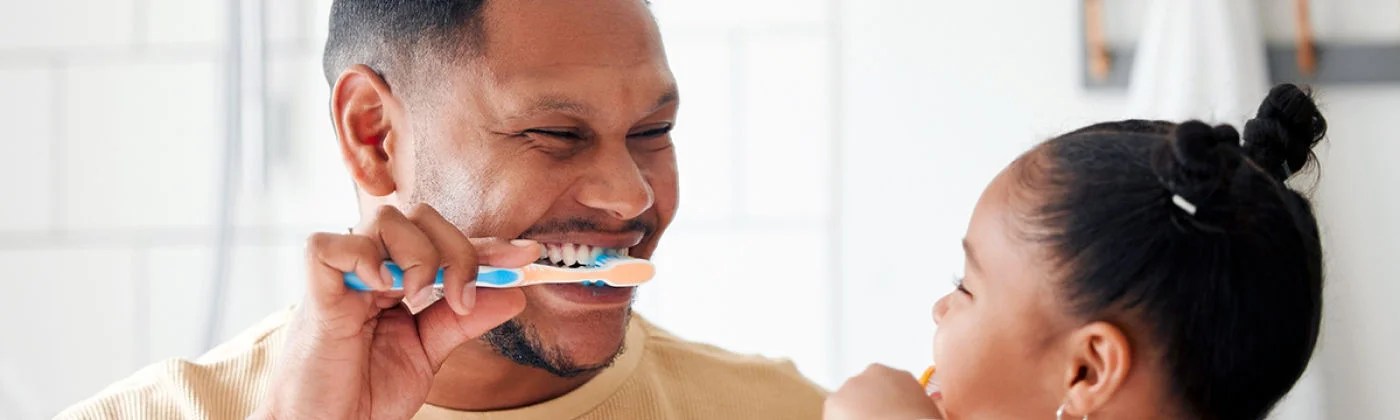
Your child’s smile can light up your day. Taking care of their teeth helps keep their smile healthy throughout childhood and into adulthood.
Daily brushing, flossing and regular dentist visits can help prevent tooth decay and cavities. Here are answers to common questions about how to protect your child’s teeth as they age.
What causes cavities in teeth?
Cavities are caused by germs and acid that eat away at the outer surface of your tooth. It creates a hole in the tooth that can be painful if it reaches the nerves inside.
About half of children ages 6 to 9 have had decayed, “filled or missing primary or permanent teeth,” according to the Centers for Disease Control and Prevention (CDC).1
You may think cavities aren’t a big deal in baby teeth, since the teeth are temporary. But untreated cavities in baby teeth can cause infection or lead to issues with eating or speaking.2
Childhood cavities can cause damage to permanent adult teeth, too. Your child’s adult teeth are in their gums just behind the baby teeth. So, infections in their baby teeth can affect their adult teeth, says Jessica Pharar, D.M.D. She’s a dentist with Drs. Chin and Pharar Dentistry in Las Vegas and the founder of the Pharar Foundation.
Plus, “caring for and brushing baby teeth sets a good example as to how best to care for adult teeth once they come in,” adds Olga Krikunenko, D.M.D. She’s a dentist and the owner of Mint Dental of Franklin, in Massachusetts.
Looking to save on cleanings and checkups without a monthly dental insurance premium? See if a non-insurance dental discount membership is a fit for your family.
Newborns: Birth to 3 months
When does dental care start?
You might not think much about your baby’s dental hygiene before they have teeth to brush. But good oral health starts even before your baby’s teeth come in.
At this age, the American Academy of Pediatrics (AAP) recommends:4
- Wipe your baby’s gums with a soft, clean cloth to remove sugars and bacteria.
- Do this twice a day: once in the morning after their first feeding and again at night.
Infant to toddler: 3 months to 3 years old
When do babies get their first tooth?
Baby teeth usually start coming in between 4 and 8 months.3
As soon as your baby’s first tooth comes in, begin brushing with a fluoride toothpaste. Fluoride is a mineral that helps prevent tooth decay. The AAP recommends:5
- Brush your child’s teeth twice a day, ideally after breakfast and at bedtime.
- Use a tiny, grain-of-rice-sized amount of fluoride toothpaste until age 3.
You may not need to worry about flossing your baby’s teeth yet. Baby teeth typically have enough space between them so that they can be cleaned with brushing alone, explains Dr. Pharar. But if your baby does have teeth that are touching, you’ll want to start flossing.
When should my child first see a dentist?
It’s a good idea to schedule your baby’s first dentist appointment by their first birthday or within six months of their first tooth. Besides checking and cleaning those first few teeth, the dentist will check on the overall health and development of your baby’s mouth, says Dr. Pharar. You’ll want to continue taking your child to the dentist every 6 months for routine cleanings and checkups.
Your dentist can also give you guidance on pacifier and bottle use, adds Dr. Krikunenko. “Those can contribute to problems with teeth and jaw if not addressed at an early age.”
Preschool to kindergarten: 3 to 6 years old
At what age can kids brush their own teeth?
By age 3, most of your baby’s teeth will have grown in. This is a good time to get them in the habit of brushing their teeth and flossing Before you let them start brushing on their own, make sure they are doing it correctly. Teach them these tricks:5,6,7
Use only a pea-sized amount of fluoride toothpaste. Too much can cause dental fluorosis, white spots that can appear on permanent teeth.
Don’t swallow while brushing. Swallowing fluoride toothpaste can also cause fluorosis. So, make sure your child spits during and after brushing.
Brush twice a day for at least 2 minutes. Set a timer or sing “Twinkle, Twinkle, Little Star” to them while they brush. Watch them brush and make sure they’re getting all the areas of their mouth.
You’ll want to supervise your child’s brushing and flossing until they are at least 7 or 8 years old.7 And Dr. Pharar suggests that you help them even longer than that, until they’re about 10. “You don’t necessarily have to be brushing your child’s teeth at that age, but at least watch them, guide them and make sure all the surfaces are getting hit and nothing’s getting missed,” she says.
Now’s the time to build good eating and drinking habits, too. Sugary foods and drinks are a leading cause of cavities in children. Encourage kids to drink water instead of sugary drinks. Tap water is best. Most cities add fluoride to tap water, which can help prevent tooth decay.
Is dental insurance or a non-insurance dental discount membership a fit for your family’s needs? Explore options online now.
School age: 6 years to 13 years old
When do kids start losing teeth?
Around age 6, your child’s baby teeth will start falling out to make room for their adult teeth, and their first permanent molars (back teeth) will come in. Molars are the most common spot for cavities. Their grooves can trap germs and plaque that cause tooth decay. Plaque is a sticky film that forms on your teeth between brushings.
These are the teeth that they’ll have for the rest of their life, so keeping up those healthy oral hygiene habits is important.
What are dental sealants and does my child need them?
Besides brushing regularly, you can help prevent cavities in your child’s molars with dental sealants. A sealant is a thin coating of protective material painted on the chewing surface of molars.
“By covering the grooves in molars, you are avoiding food and plaque getting lodged deep inside and causing decay,” explains Dr. Krikunenko. “I recommend getting sealants when molars first start to show up in the mouth, which is around 6 years of age.” You’ll want to get sealants again around 12 years when the second set of molars comes in.
Once applied, sealants can last a long time. Your child’s dentist will check on them at each visit and recommend touching up or replacing sealants as needed.
If your child plays contact sports, ask your dentist about a custom or over-the-counter mouthguard to help protect their teeth from injury.
How can I get coverage for my child’s dental care?
There are a few ways to help cover your child’s dental care, depending on your situation. Here are some of the most common options.
ACA Marketplace plan
If you enroll in a health insurance plan on the ACA Marketplace, dental coverage for kids under 18 must be offered.8 That’s because pediatric dental care is considered an essential health benefit under the Affordable Care Act.8 It can come bundled with your health plan or as a separate plan you add on. Dental coverage for adults typically requires a separate (supplemental) dental insurance plan.
Employer-sponsored plan
If you get health insurance through a job, ask if dental coverage for your child is included. Check your plan details, since you may need to add a separate dental plan or pay an additional fee to cover your child’s care.
Supplemental dental insurance
A supplemental dental health insurance plan can help pay for cleanings, X-rays, fillings and other dental care. There may be a cap on how much the plan pays each year. You can buy dental insurance as a separate plan, even if you already have health coverage.
Dental discount card (non-insurance)
With a dental discount membership, which is a non-insurance product, you pay a fee for lower, set prices at participating dentists. It’s not insurance. There are no yearly maximum or claims to file, which can make it a convenient option if you don’t have dental insurance.
Every family’s dental needs look a little different. A licensed insurance agent can help you understand your options.
Frequently asked questions
What should I do if my child’s tooth gets knocked out or chipped?
If a permanent tooth gets knocked out, keep it moist in milk or saliva, and get to a dentist right away. The longer you wait, the lower the chance the tooth can be saved.9 Baby teeth are not put back in place. Call your dentist right away if a baby tooth is knocked out or chipped. You can use gauze to press gently on the gum to stop any bleeding.
When should my child start using fluoride toothpaste, and how much?
The American Academy of Pediatrics (AAP) recommends starting fluoride toothpaste as soon as your child’s first tooth comes in. Use a smear, about the size of a grain of rice, until age 3.5 After that, switch to a pea-sized amount. Keep supervising brushing so your child spits out the toothpaste instead of swallowing it.6
My child grinds their teeth at night. Is that normal?
Teeth grinding, called bruxism, is common in young kids. It often goes away on its own, usually by age 6.10 Mention it to your child’s dentist at a routine visit. It’s more of a concern if you notice worn or chipped teeth, or if your child complains of jaw or ear pain.
Is thumb sucking or pacifier use bad for my child’s teeth?
Thumb sucking and pacifier use are normal for babies and toddlers. Most kids stop on their own between ages 2 and 4.11 If the habit continues, it may affect how your child’s teeth and jaw line up. Talk to your dentist about your child’s thumb sucking or pacifier use at checkups.
Jessica Pharar, D.M.D., is a dentist with Drs. Chin and Pharar Dentistry in Las Vegas and the founder of the Pharar Foundation.
Olga Krikunenko, D.M.D., is a dentist and the owner of Mint Dental of Franklin in Massachusetts.
For informational purposes only. This information is compiled by UnitedHealthcare, and/or one of its affiliates, and does not diagnose problems or recommend specific treatment. Services and medical technologies referenced herein may not be covered under your plan. Please consult directly with your primary care physician if you need medical advice.
Find the dental coverage that fits your family’s health needs and budget. Browse plans online, or call a licensed insurance agent at 1-844-211-7730 to learn more.
Sources:
- Centers for Disease Control and Prevention (CDC). “2024 Oral Health Surveillance Report: Selected Findings.” Reviewed October 9, 2024. Retrieved from https://www.cdc.gov/oral-health/php/2024-oral-health-surveillance-report/selected-findings.html
- Centers for Disease Control and Prevention (CDC). “Cavity Facts.” Accessed September 19, 2026. Retrieved from https://www.cdc.gov/oral-health/data-research/facts-stats/fast-facts-cavities.html
- MedlinePlus (NIH/NLM). “Dental care – child.” Reviewed Feb 5, 2026. Retrieved from https://medlineplus.gov/ency/article/002213.htm
- HealthyChildren.org (American Academy of Pediatrics). “Oral Health During Pregnancy & Infancy.” Updated August 11, 2026. Retrieved from https://www.healthychildren.org/English/ages-stages/prenatal/Pages/Protect-Tiny-Teeth.aspx
- HealthyChildren.org (American Academy of Pediatrics). “Good Oral Health Starts Early: AAP Policy Explained.” Updated April 17, 2026. https://www.healthychildren.org/English/healthy-living/oral-health/Pages/Brushing-Up-on-Oral-Health-Never-Too-Early-to-Start.aspx
- HealthyChildren.org (American Academy of Pediatrics). “Fluoride for Children: Parent FAQs.” Updated April 24, 2025. Retrieved from https://www.healthychildren.org/English/healthy-living/oral-health/Pages/FAQ-Fluoride-and-Children.aspx
- MedlinePlus (National Library of Medicine/NIH). “Brushing Your Child’s Teeth.” Updated April 5, 2025. Retrieved from https://medlineplus.gov/ency/patientinstructions/000769.htm
- HealthCare.gov. “Dental Coverage in the Health Insurance Marketplace.” Accessed August 12, 2026. Retrieved from https://www.healthcare.gov/coverage/dental-coverage/
- MedlinePlus (National Library of Medicine, NIH). “Broken or knocked out tooth.” Reviewed February 5, 2026. Retrieved from https://medlineplus.gov/ency/article/000058.htm
- HealthyChildren.org (American Academy of Pediatrics). “Teeth Grinding in Children: What to Know About Bruxism.” Updated April 17, 2026. Retrieved from https://www.healthychildren.org/English/healthy-living/oral-health/Pages/Teeth-Grinding-in-Children.aspx
- HealthyChildren.org (American Academy of Pediatrics). “Baby Pacifiers & Thumb Sucking: What Parents Need to Know.” Updated January 20, 2026. Retrieved from https://www.healthychildren.org/English/ages-stages/baby/crying-colic/Pages/Pacifiers-and-Thumb-Sucking.aspx
Compliance code: 49818-X-0926